How Threshold Works

Methodology

Threshold maps medical conditions to the environmental and design factors that affect them. This page is the practitioner's tour of how the work is built: how to read an entry, what the evidence labels mean, and how Threshold organizes the environment a human body lives in.

The Three-Layer Architecture

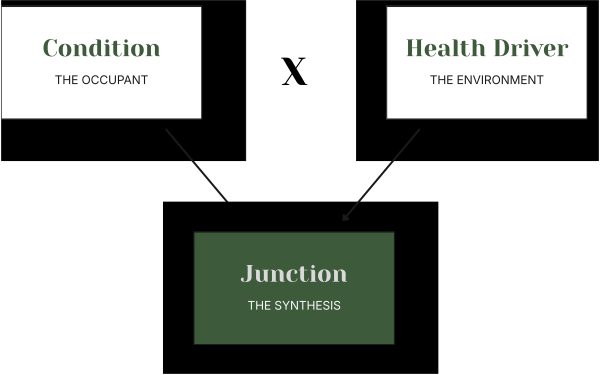
Threshold is organized around three core entities. Together they form a triangulation: a medical condition, an environmental phenomenon, and the specific connection between the two.

Diagram showing Condition times Health Driver equals Junction.
One Condition + One Health Driver = One Junction

Conditions

What is happening in the human body. Each Condition is a medical diagnosis or recognized condition, organized so practitioners can find it the way they would expect to.

Health Drivers

What is happening in the environment. Each Driver names an environmental phenomenon the body responds to: flicker, mold and mycotoxins, thermal stress, dirty electricity, and others.

Junctions

The intersection. Each Junction is one Condition paired with one Health Driver, holding the specific information a practitioner needs: why this Driver matters for this Condition biologically, the strength of evidence behind that connection, and the design recommendation tailored to this pair.

Most reference works on healthy building organize either by environmental hazard or by best practice. Threshold organizes by the third axis: the occupant.

How Conditions Are Organized

Threshold uses ICD-11, the World Health Organization's diagnostic taxonomy, as the spine for clinical classification. Chapter labels are laymanized so practitioners can navigate without medical training. Where ICD-11's chapter assignment diverges from a practitioner's intuition, Threshold defaults to the lay designation. Each Condition also carries lightweight metadata for filtering by trajectory, pathological mechanism, and environmental phenotype.

The 19 ICD-11 chapters used by Threshold
ChapterExample Conditions
Infections & ContagionsLyme disease, Long COVID, chronic EBV
Tumors & CancersBreast cancer, lymphoma, glioblastoma
Blood DisordersSickle cell disease, hemophilia, thalassemia
Immune & Autoimmune ConditionsMultiple Sclerosis, Lupus, MCAS, CIRS
Hormonal & Metabolic DisordersType 1 & 2 diabetes, Hashimoto's, PCOS
Mental & Behavioral ConditionsAutism, ADHD, depression, bipolar disorder
Sleep DisordersInsomnia, sleep apnea, narcolepsy
Neurological DisordersParkinson's, Alzheimer's, epilepsy, migraine, TBI
Vision & Eye ConditionsMacular degeneration, glaucoma, photophobia
Hearing & Ear ConditionsTinnitus, Meniere's disease, hyperacusis
Heart & Vascular ConditionsPOTS, hypertension, atrial fibrillation, tachycardia
Respiratory ConditionsAsthma, COPD, cystic fibrosis
Digestive & Gut ConditionsIBS, Crohn's disease, celiac, ulcerative colitis
Skin ConditionsEczema, psoriasis, vitiligo
Mobility, Bone & Joint ConditionsRheumatoid arthritis, osteoporosis, EDS, fibromyalgia
Urinary & Kidney ConditionsInterstitial cystitis, chronic kidney disease
Sexual & Reproductive ConditionsEndometriosis, infertility
Pregnancy & PostpartumPreeclampsia, hyperemesis, postpartum depression
Newborn & Infant ConditionsFailure to thrive, neonatal abstinence syndrome

Health Drivers and the WHOLESOME Framework

A Health Driver is what the body is actually responding to. The naming discipline is patient-effect: Drivers are defined at the level of the biological response, not at the level of what builds the exposure or what mitigates it.

Drivers are organized by WHOLESOME, a nine-domain framework developed by Courtney Lebedzinski and drawn from her work at Wholesome Houses. Threshold uses it as the spine that places every Driver in its native home.

W

Water & Air Quality

What the body takes in by breath, sip, and skin, thousands of times a day, without asking permission. Source-water composition, whole-house and point-of-use filtration, mechanical fresh-air strategy, particulate and gas control, real-time monitoring.

In ThresholdParticulate Matter, Volatile Organic Compounds, Ozone, Disinfection Byproducts.

H

Habitat & Bioclimatic Design

Site, orientation, climate, and the body's spatial relationship to the building. The decisions made before walls go up. Universal Design lives here, alongside thermal regulation and the spatial design of the home for the actual occupants.

In ThresholdThermal Stress, Fall Hazards, Non-Adaptive Built Environment, Insufficient Exercise Infrastructure.

O

Occupant Health & Exposure

The materials side of healthy design. Anything the body touches, breathes around, or inherits from the slow off-gassing of finishes and furnishings. Solid wood instead of particleboard, mineral paints instead of synthetic, the chemistry the household will live with for the next thirty years.

In ThresholdPersistent Organic Pollutants, Bisphenols & Phthalates, Pesticides, Heavy Metals, Flame Retardants.

L

Light, Sound & Sensory Design

The sensory environment the nervous system is reading constantly, faster than the conscious mind can name. Light spectrum and timing, acoustic absorption and reflection, the proportions of the space, the materials' visual and tactile honesty.

In ThresholdFlicker, Glare, Light Intensity, Insufficient Daylight, Acoustic Overload, Circadian Disruption.

E

EMF & Electrical Hygiene

The electrical environment shared between the building's wiring and the human nervous system. Wiring methods, bedroom kill-switches, hardwired internet, lighting selected for clean electrical signatures, the home's electrical system treated as a health system because that is what it has quietly become.

In ThresholdDirty Electricity, Magnetic Fields, RF Radiation.

S

Sovereignty & Resilience

The home's capacity to keep functioning when the systems it depends on do not. Energy, water, food, and medical-equipment continuity through outages, boil notices, and supply-chain interruptions.

In ThresholdEngaged where resilience is a design-relevant concern in the condition itself: insulin-dependent conditions and grid reliability, oxygen-dependent conditions and emergency power, severely immunocompromised occupants and water-event preparedness.

O

Occupant Behavior & Maintenance

How the home is operated and maintained over decades. Filters do not change themselves, dehumidifiers do not service themselves, and cleaning products can undo the work the materials were supposed to do.

In ThresholdEngaged primarily through Junction recommendations rather than standalone Drivers; operational behavior is a design output more than a design input.

M

Mold, Moisture & Microbes

Moisture is the master variable in maintaining a bio-compatible microecology. Get this one wrong and nothing else matters, because the house becomes a slow biological event. Vapor-open assemblies, dedicated dehumidification, drainage planes, capillary breaks, and envelope details decide whether the cascade gets started.

In ThresholdMolds & mycotoxins, bacteria & endotoxins, microbial VOCs.

E

Ecology, Community & Place

The home's relationship to its context. Where the materials came from, what energy ran them, where the water leaves to, what the land was before and will be after. The layer where Building Biology meets ecological design.

In ThresholdEngaged primarily through source-side specifications inside Drivers rather than as discrete Health Drivers.

Parcel-Scale Scoping

Health Drivers in Threshold are limited to environmental phenomena that can be addressed at the parcel scale: the lot, the building, and what is installed in or on it. Off-parcel influences are out of scope, even when they are real and meaningful to occupant health. The reason is sphere-of-influence. Practitioners make parcel-scale decisions.

Where an off-parcel influence does have a parcel-scale response, the response itself is in scope and lives inside the relevant Driver's Interventions.

Junctions: Where Synthesis Lives

A Junction is one record per Condition x Health Driver pair, and it answers three questions.

1. Why does this Driver matter for this Condition specifically?

The mechanism field describes the biological pathway connecting the two. It is not a re-narration of the Driver's generic mechanism; it is a condition-specific explanation.

2. How strong is the evidence?

Every Junction carries an evidence tier rating the connection itself: not the Driver and not the Condition, but whether this Driver actually affects this Condition.

3. What should the practitioner do?

The recommendation selects and prioritizes from the Driver's Interventions list for this specific Condition. Recommendations are applied Driver knowledge, not repeated Driver knowledge.

Relationship Type

Each Junction is tagged with one or more relationship types, describing how the Driver relates to the Condition across time.

Risk - increases likelihood of developing the conditionTrigger - exacerbates the condition once it existsProgression - accelerates disease course over time

Evidence Tiers

Every Junction in Threshold carries an evidence tier. The tier rates the connection: how strong is the evidence that links this Health Driver to this Condition?

TierWhat It Means
Tier 1Strong research consensus. Multiple high-quality studies establishing the connection.
Tier 2Moderate evidence. Smaller body of published literature, generally aligned in direction.
Tier 3Clinical observation across multiple practitioners. Repeated, named, and consistent, even where formal study is thin.
Mechanism established and reasoning sound; specific published evidence for the connection is limited.

Tiers live on Junctions, not on Drivers, because the same Driver connects to different Conditions with different evidence strengths. Tier is a property of the connection. For example, the flicker/epilepsy connection has stronger evidence than the flicker/multiple sclerosis connection.

Tier 4: A Working Tool

Healthy building does not have the research budget of pharma. Many of the connections practitioners encounter daily have thin published literature behind them and strong mechanistic reasoning in front of them. Building Biology operates on the precautionary principle, and Tier 4 is how that principle expresses itself inside the database.

Tier 4 entries are flagged so practitioners can weigh them deliberately. They are never camouflaged as established research, and Threshold does not publish speculation.

Lanes: What Threshold Does and Does Not Do

Threshold Does Not
  • Estimate cost. Cost varies by region, build phase, spec quality, and trade availability.
  • Label severity categorically. Priority order, evidence tier, and recommendation prose carry the priority signal.
  • Make medical recommendations. Clinical management is the clinician's lane.
  • Make claims about curability in Condition Overviews.
Threshold Trusts the Practitioner To
  • Weigh costs and trade-offs against the client's reality.
  • Decide what is feasible for a given build and budget.
  • Resolve tensions the database names but does not resolve.
  • Bring clinical judgment about the specific client in front of them.
  • Find solutions and workarounds the database has not enumerated.

Contribute to the Framework

Are you a researcher or medical professional interested in refining these junctions?

Contact Research Lead

Last reviewed: May 2026